
Need to cover a large area? A single private 5G radio on your own mast, crane, or rooftop covers the whole jobsite — laydown yards, floors, basements, and the gate trailer — with capacity you don’t share with the highway. West Networks designs it, installs it, and runs it. This page explains how it works and when it’s the right call.
The problem no hotspot solves
Construction sites are the worst case for ordinary connectivity. The footprint is huge and mostly outdoors, the buildings are concrete and steel, and the site changes shape every month. Wi-Fi mesh needs a repeater every couple hundred feet and dies with every wall pour. Public cellular means sharing whatever tower serves the area with everyone stuck in traffic next to it — and the moment your cameras, tablets, sensors, and access control all come online, you’re the heaviest user on a network you don’t control.
Bonded 5G routers (the approach covered across this site) solve the uplink — getting reliable internet to the site. Private 5G solves the other half: distributing dependable coverage across the site, to hundreds of devices, without trenching cable or babysitting mesh nodes.
What private 5G actually is
Private 5G is your own cellular network: your own radios, your own SIM cards, and your own network core, running on spectrum reserved for exactly this. In the US that spectrum is CBRS (3.55–3.7 GHz) — you don’t need to own a license, but every radio must be registered and coordinated through an FCC-designated Spectrum Access System by a Certified Professional Installer. West Networks is CPI- and SAS-registered, so that compliance work is part of the install, not your problem.
Devices join it the way they join any carrier: with a SIM. Cameras, tablets, and telemetry gear with 5G modems connect directly; everything else connects through a 5G router that treats your private network as its WAN.
Set up your own tower
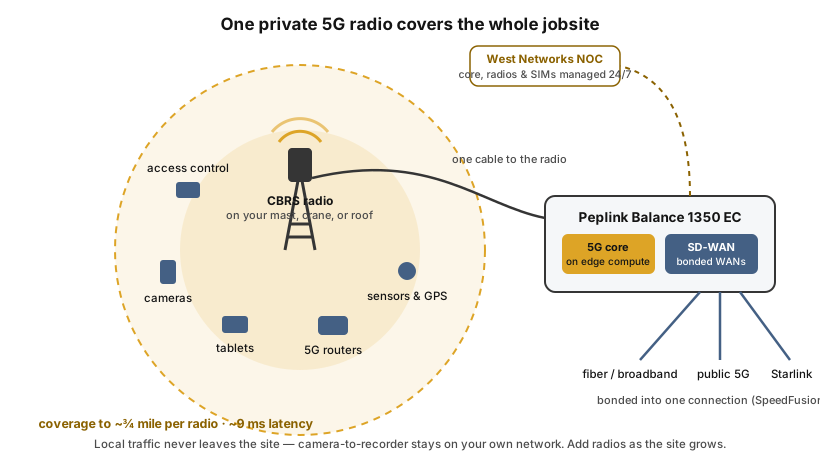
This is the part that surprises people: coverage that would take dozens of Wi-Fi access points comes from one radio. Mount it on a light mast, a crane, a container, or the structure itself — a single CBRS radio reaches out to roughly three-quarters of a mile, and because the network core is on the site with it, latency stays in single digits. Multi-building campus or a mega-site? Add radios; they behave as one network.
Field note
On a live customer jobsite deployment, we measured 9 ms of latency at three-quarters of a mile from the radio — with four radios blanketing the full site. Local traffic (a camera talking to an on-site recorder) never leaves the property.
When the job wraps, the network moves. The radios unbolt, the core appliance goes in a truck, and the same kit lights up the next site — nothing about private 5G is poured in concrete.
The core: no data center required
Every cellular network needs a core — the brain that authenticates SIMs, manages sessions, and moves traffic. Carriers run theirs in regional data centers. Ours runs on your site, as a workload on the Peplink Balance 1350 EC’s built-in edge compute — the same appliance that bonds your internet uplinks (fiber, public 5G, Starlink) with SpeedFusion. One rack unit runs the entire site: private cellular on one side, bonded WAN on the other.
That placement is why the latency number above is possible, and it means the private network keeps working site-wide even if every uplink drops — cameras keep recording, access control keeps working, and the bonded WAN brings the internet back when it can.
Managed by West Networks
A private cellular network sounds like something that needs a telecom engineer on staff. It doesn’t — because you’re not the one operating it:
- 24/7 NOC operation. Every core reports health, radio status, and per-second telemetry to the West Private 5G platform. We see a problem before your crew does.
- SIMs in minutes. New subcontractor gear? We issue a SIM from the platform — credentials generated fresh, stored encrypted, written to the card, live on your core immediately.
- SIMs that roam between your sites. Every SIM carries an approval list: approve it onto any site you run and it connects the moment it arrives. A superintendent’s truck or a survey kit moves between jobsites and its connectivity moves with it — no reprovisioning, no site visit.
- Spectrum compliance handled. CPI-installed, SAS-registered, and kept compliant as the site (and its cranes) change.
- Public static IPs when you need them. Remote access to site systems without carrier NAT, delivered over SpeedFusion.
Honest boundary: when you don’t need it
If your site is a single trailer and a handful of tablets, private 5G is overkill — a bonded 5G router with a good antenna is the right tool, and it’s covered end-to-end in our router and kit selector. Private 5G earns its keep when the area is the problem: multi-acre sites, multiple buildings, hundreds of devices, RF-hostile structures, or jobs where camera and safety coverage is contractual.
Common questions
Do we need an FCC license?
No. CBRS General Authorized Access spectrum is coordinated per-radio through a Spectrum Access System. Registration is mandatory — a license is not. We handle it.
What devices can use it?
Anything with a 5G modem and a SIM slot — cameras, tablets, gateways, telemetry units — connects directly. Laptops, recorders, and legacy gear connect through a 5G router or bridge on the private network.
Do we still need internet service?
For cloud apps, yes — the same appliance bonds fiber, public 5G, and Starlink into one resilient uplink. But site-local traffic stays on site, and the private network keeps running even with every uplink down.
What happens when the job ends?
The network redeploys. Radios, core appliance, and SIMs move to your next site — and because SIMs roam between sites, gear that’s already carrying one connects the day the new radios go up.
How long does deployment take?
A site survey drives the design; a typical single-radio site is live within days of hardware arriving — not the months a trenched or leased-line build takes.
Where to go next
See how this fits the bigger construction picture in our case studies, or talk to the team that builds these networks.